Nearly knowledgeable's New Blog Site
The Wrekin: A Place of Magic and Forgotten Warriors
Discover the enchanting beauty of The Wrekin, a magical place where fairies, goblins, and forgotten warriors once roamed. Explore the steep routes and immerse yourself in the captivating legends that surround this stunning landmark.
Amy Boucher
11/4/20214 min read
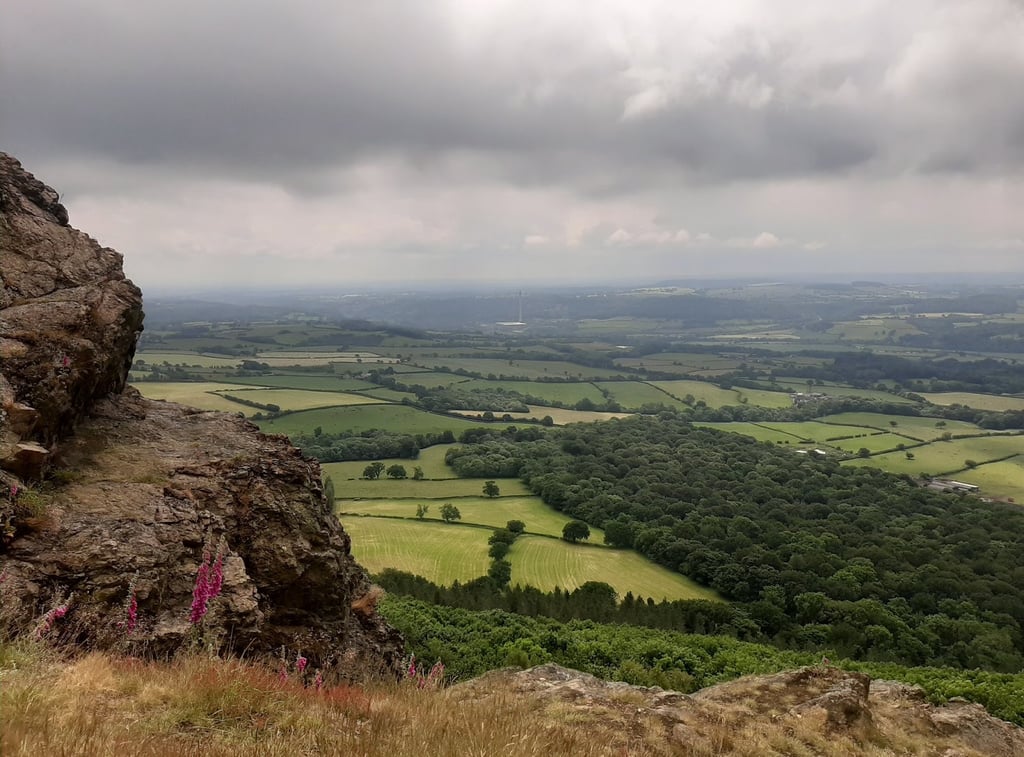
The Wrekin
I grew up in the shadow of the Wrekin. My childhood seemed to be a patchwork of long Sundays exploring its surrounding woods and treading its well-worn path. It appeared to me as something out of the mind of Tolkien (who indeed used to walk the same paths as me during his time living in Penkridge) The Wrekin- in my mind will forever be a place of magic, and wholly beautiful. I used to imagine fairies and Goblins, wild tree men as well as a Motley Crue of long-forgotten warriors, who once lived on its summit. The route up the Wrekin is steep, but whenever you reached the ‘Halfway house’ café you could ruminate and reflect on your journey over a Twix or mars bar, looking out over the green valley, and think about the view from the top. Sitting 5 miles west of Telford, It is a contained in the northern panhandle of the Shropshire hills, and at 1,335 ft on a clear day the views are to die for- including Staffordshire and the black country and as far as Winter Hill in Lancashire and the Manchester Beetham Tower. Thus, as a kid it felt like the mantle of the world, like nothing could be higher, or more important, it was my own personal Amon Hen.
The whole area has a rich geographical and historical significance. Now I am no expert Geologist, but it is worthy of note that at least in part it is formed from rocks of volcanic origin of Precambrian age. These include rhyolites, tuffs, and agglomerates. These rocks – layers of ancient lava flows laid down in a volcanic island arc, like modern Japan – are approximately 680 million years old (Though it is worthy of note that the Wrekin was never an active volcano) If this is something that interests you further you should definitely look into it.
Historically, the earliest mention of ‘The Wrekin’ is in a charter of 855. This was entered into a later 11th century Worcester cartulary and spelt ‘Wreocensetun’. Its modern form is said to have come into being via the way of Mercia and have been taken from the early Celtic ‘Wrikon’ There also existed a minor Anglo-Saxon kingdom called ‘Wreocensæte’ which was later absorbed into Mercian reign. Interestingly, for several centuries the hill was known as Mount Gilbert which was given to it by the Normans after a hermit who lived there.
One of the most captivating things about The Wrekin is that near its summit lies the site of an iron age hill fort. It is thought to be at least 20 acres in size, and was known as Caer Uriconio, an important site for the Cornovii tribe and was perhaps the site of their capital before the Romans had them moved to Wroxeter (Viroconium Cornoviorum). The size of such a settlement suggests that it was occupied by a large community where centralised economic and social activities were practiced, including the storage and redistribution of food and the performing of ceremonies. The defensive strength of the hillfort is enhanced by its topographic location, with the surrounding ground sloping steeply in all directions. It certainly is enthralling to think that for a whole community- the Wrekin was home and wonder if this played a part in its later cultural importance to Shropshire folk- after all they say a ‘Shropshire mon is nevver lost if he can see the Wrekin’. This hill is important to us.
When we reach the 18th and 19th century, the Wrekin was certainly a popular attraction. It became the ‘thing to do’ to ascend the slopes and was quite fashionable to walk up the Wrekin.
Similarly, during the 18th century (and perhaps earlier, its origins are lost in time) a festival known as ‘The Wrekin Wakes’ took place on the first Sunday in May. This saw local people ascend the hill on mass, where the ‘pleasure seekers’ would be met…
“With ale-booths, ginger-bread-standings, gaming-tables, swing-boats, merry-go-rounds, three-sticks-a-penny, and all the etcetera’s of an old English fair.”
One cannot help but smile whilst imagining such a sight. The event’s climax was the yearly battle between the Colliers and the Countrymen for the possession of the hill. Such a ceremonial spectacle would have been great to witness and reminds me of the battle between The Green Man and Ice Queen at the Clun Green man Festival, just with far more violence. Charlotte Burne recounts that if one side was being seen to be losing early, they sent messengers around the local village for reinforcements. Sometimes the two sides were evenly balanced, and apparently the men of Wellington often took the side of the countrymen over the miners. Nevertheless, this was seen as such fun, despite the fighting being severe, and often causing fatal injuries.
Apparently, this practice caused such disorderly scenes, that when the Cludde family of Orleton bought the manorial rights, over the first portion of the hill, they determined to put down the Wake by force, and employed a party of Gamekeepers and Constables to clear the hill. The Wake continued in some form or another though as it was described in 1826 as a time to drink to the health of ‘all the friends around the Wrekin’ and was seen as more of a moral failing to participate. I love knowing such a ruckus took place and cannot help but admire the fitness of the poor messengers having to traipse up and down the Wrekin’s slopes.
The Wrekin also has a number of folk tales attached to itself, including two ‘origin’ stories. I have retold my favourite of the two here, I hope you find them as interesting as I do.
Contact
© 2020 - 2026. All rights reserved.