Nearly knowledgeable's New Blog Site
The Wrekin: Telford's Beloved Landmark
Discover the significance of The Wrekin to Telford's identity. This iconic hill, steeped in history and folklore, including the famous devil tale, inspires pride among locals and embodies a unique spirit of place.
Amy Boucher
3/3/202512 min read
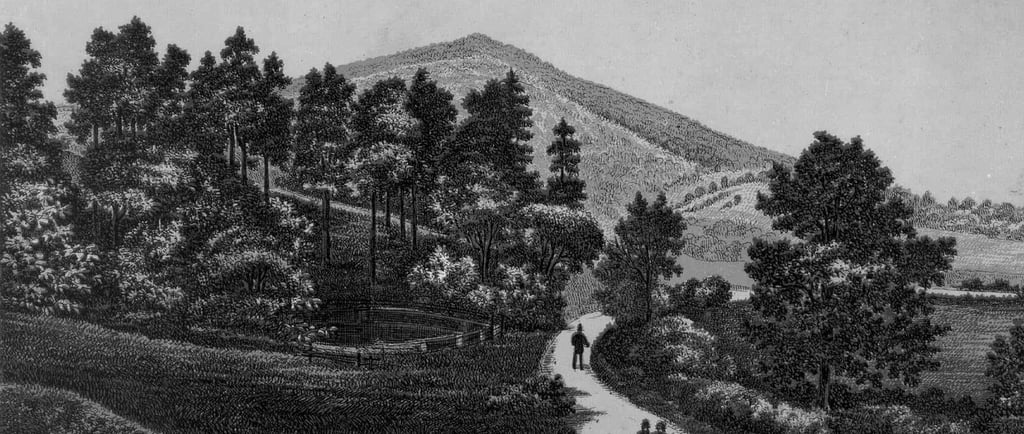
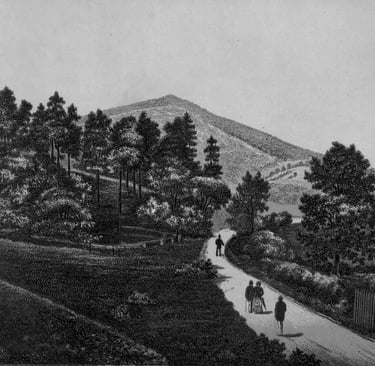
The Wrekin Devil
There are some landscapes that simply exude their folklore. The very wind whispers the names of the spirits inhabiting that place. They are a firework in the mind of a child. For me, The Wrekin was my firework. I grew up in the shadow of the Wrekin, and sure enough it became the axis of my known world. As a child it felt like nothing could be higher, or more important, it was my own personal Amon Hen and as I grew and moved away, I began to understand the maxim ‘a Shropshire mon is nivver lost if he can see the Wrekin’. I am pleased to say that as I write, I can see it from my living room window, and I feel that part of me is has been found again after all of these years.
The Wrekin has had many lives, too many to commit to this page, however in part its story began during the Precambrian age, when it formed from layers of ancient lava flow. It was never a volcano itself, but this makes the Wrekin approximately 680 million years old. The earliest mention of ‘The Wrekin’ is in a charter of 855. There also existed a minor Anglo-Saxon kingdom called ‘Wreocensæte’ which was later absorbed into Mercian reign. During the 11th century it was referred to as ‘Wreocensetun’ in the Worcester cartulary- (Also Known as Hemmings Cartulary) one of the earliest cartularies which is still held in Worcester cathedral library. A cartulary is a collection of legal transcripts or charters pertaining to land ownership and other factors which became pertinent in a post conquest world. Interestingly, for several centuries the hill was known as Mount Gilbert. This was after a hermit who took up residence upon the Wrekin. Gilbert wasn’t the only Hermit who chose the Wrekin as a place for isolation and contemplation. During the reign of Henry III, a hermit called Nicholas De Denton had a crude hermitage somewhere on the Wrekin. In 1267 the king made a grant in support of De Denton pledging to ‘give the hermit greater leisure in holy exercises and support him during life so long as there shall be a hermit on the aforesaid mountain’. The Wrekin has always been a special place, a place with such a strong sense of itself, a place worthy of inspiring such acts of devotion or creativity.
One of the most captivating things about The Wrekin is that near its summit lies the site of an iron age hill fort. It is thought to be at least 20 acres in size, and was known as Caer Uriconio, an important site for the Cornovii tribe and was perhaps the site of their capital before the Romans had them moved to Wroxeter (Viroconium Cornoviorum). The size of such a settlement suggests that it was occupied by a large community where centralised economic and social activities were practiced, including the storage and redistribution of food and the performing of ceremonies. The defensive strength of the hillfort is enhanced by its topographic location, with the surrounding ground sloping steeply in all directions. As I have mentioned in previous articles, by the time we reach the 18th and 19th century, the Wrekin was certainly a popular attraction. It became the ‘thing to do’ to ascend the slopes and was quite fashionable to walk up the Wrekin. During the 18th century (and perhaps earlier, its origins are lost in time) a festival known as ‘The Wrekin Wakes’ took place on the first Sunday in May. “With… all the etcetera’s of an old English fair” The event’s climax was the yearly battle between the Colliers and the Countrymen for the possession of the hill. These fights were usually brutal and would have to be broken up by local bailiffs.
The Wrekin is immensely important to people in Telford. Our little mountain (though technically not one) instils such a sense of pride that has weaved its way into our identity and indeed this has always been the case. H.Timperley wrote in the 19th century that to local people ‘The Wrekin was as much a spirit as a hill… when you go up it, the underlying mood or feeling was that of a pilgrimage’. He continues to suggest that ‘few places have a greater spirit of place than the Wrekin’ and I am inclined to agree. Understandably then, this spirit of place and its long history has been the subject of a great body of folklore, including our Devil tale.
There are actually quite a few versions of the Wrekin’s origin story, perhaps the most famous concerns a rather dim-witted giant known as Gwendol ap Wrekin ap Shenkin Myndmawr. Other versions suggest two giants were the agents of its creation. It seems the origins of the Wrekin have always been a subject of discussion, with folklorist Jaqueline Simpson remarking that as late as the 1970s she was receiving different versions of the tale whilst collecting oral stories in the wider area. One version that is often left out of discussions regarding the landmark concerns The Devil, and how Owd Scratch brought the Wrekin into existence.
There has been some debate regarding the origins of this version of the story, with some suggesting the devil narrative is actually earlier than the two main ‘giant’ accounts. I think that this is quite hard to discern, especially considering both versions would have begun their lives as oral accounts. It is probable that both stories could have existed in tandem shared and favoured by different groups in the same vicinity. Folklore is never and I believe that there is rarely one authentic version of a folk tale.
Some of the earliest written references I have found to the Devil origin story come from 1849, in newspapers and antiquarian writings now available through the British newspaper archive. The story seems to have been very much in vogue during this year, as it is featured in a number of publications, both local and further afield. It is not until 1860 that we see the Devil’s role in the creation of the Wrekin becoming more widely known or at least written about. Hiram Howell included the Devil in his versified retelling of the Wrekin Legend in his ‘The Wrekin Legend… An ancient tale in modern verse’ collection of poems though his version differs slightly from the 1849 account. Howell addresses the age of the Devil narrative early on in the poem, where he states, ‘the date I know not, but who cares for the date?’, seemingly trying to brush over it. He claims the tale took place ‘in the olden days’ and that it is an ancient tale. Here Hiram Howell is clearly trying to embed the narrative in a much earlier time frame and link it to the wider corpus of mythology. There is an idea that the older a tale is, the more authentic it may be and there was a resurgence in the interest in folklore and mythology during this period. Though Hiram Howell doesn’t help us date the Devil narrative, what is clear is that in all likelihood it would have been in circulation prior to being written down in 1849.
In the 1880s, the narrative had shifted in favour of Giants. Georgina Jackson and Charlotte Burne opted to use the giant narrative in the study of Shropshire folklore ‘A Sheaf of Gleanings’. The popularity of the giant narrative can in many ways be traced back to this text as it had monumental influence both inside and outside of the county. This version of the narrative saw the clumsy and vengeful Gwendol ap Wrekin ap Shenkin ap Myndmawr create the Wrekin after he was outwitted by a canny cobbler from Wellington. Despite the popularity and eventual proliferation of the Giant narrative, I believe that it is still worth sharing the Devil story in this book. It demonstrates to us the fluidity of folk narratives and also suggests there seems to be an intrinsic link between the character of the Devil and landscape. It’s important to emphasise that it is unlikely anyone believed any of the folk narratives were the actual origins of the landmark. Instead, the folklore that has developed around the Wrekin should be seen as a testament to the creativity of ordinary people, and the complex ways in which we engage with our environment. The landscape inspires us in a deep-rooted way, we are driven to weave narratives that reach all the way to the Wrekin’s summit.
Furthermore, it is important to highlight that in many of our written accounts, the 1849 Wrekin Devil story narrative mirrors the Gwendol story almost explicitly. I believe that this demonstrates the evolution of the tale through the same narrative framework, with the only major difference being that the Devil takes centre stage. Charlotte Burne makes an interesting point when she states that the conception of The Devil as ‘the hardworking, easily-cheated fiend who appears in popular stories throwing stones… pulling down buildings, — is well-known to have been directly derived from the giants of older mythology’. The two creatures influence each other within the folkloric context, and thus it explains why two legends could be linked to the same landmark. I want to briefly return to Hiram Howell’s poetic retelling of the Devil narrative as it differs slightly from our 1849 account. Hiram Howell’s describes a Devil who was once welcomed to Shrewsbury in the form of a stranger, wearing ‘a coat of black, trousers and vests sombre too’ (This is very similar to the description from the Jackfield narrative). When the town realises that it is the Devil, the priests bless the ground, so he is incapable of visiting. The mayor of the town turns to piety and bans any frivolity from within the town walls. This angers the Devil, who becomes more and more spiteful. Eventually he decides to act and attempt to dam the Severn with a spade of earth. The Severn is described as being held in high regard, which links to the classical understanding that the River Severn was the abode of Sabrina the Goddess. Having decided on the plan, the Devil summons one of his minions ‘a grim goblin, who straight obeyed almost e’er word he said’. It is this goblin that carries the spade of earth and is eventually bested by the clever cobbler, who is described as a humble and simple ‘country shoemaker’. I like Hiram’s version as it adds depth to the narrative by showing both the build-up and aftermath of the Devilish encounter but clearly differs from the folkloric narrative. It was clearly intended to entertain and for popular audiences. I would like to now share my own retelling of the Wrekin Devil narrative, which has been heavily influenced by the 1849 versions of the story that are found within the newspaper archive.
It is common knowledge that although the Devil hates the whole of England, he holds a particular spite for Shropshire. Indeed, he was said to have hated the county more than anywhere else and spent much of his time plotting its downfall. (Interestingly, The Devil’s hatred of Shropshire is mirrored in other landscape narratives, and if frequently attributed to the people of Shropshire being good protestants and knowing their scripture) One of the most annoying things for Owd Scratch was the noise, for when he sat in the Welsh Hills, he could hear nothing but an incessant hullabaloo coming from the county, especially from Shrewsbury. He hated Shrewsbury and its mayor most of all.
One day, he resolved that he couldn’t take any more of the racket and decided to end the county once and for all. After a while, he came up with the perfect plan, he was a crafty owd mon after all. He picked up his shovel and struck the floor, dragging up the earth below. The plan was simple, he would take the heavy earth and journey to the river Severn, where he would dam its flow, causing a catastrophic flood. This flood would be nothing like the county had seen before and promised a watery grave for Shrewsbury’s inhabitants. So, the Devil took to the roads with his spade full of earth and walked the familiar route into Shropshire. It was a hot day, and the longer he walked, the more he struggled under the weight of the earth. The sweat dripped from his brow, and he grew exhausted. He didn’t think it was that far when he set off, but it seemed to be taking him forever to arrive. He began to feel disoriented, as he went round in circles.
A short while later The Devil began to hear footsteps approaching. They were a slow, dragging sort of footstep, but soon enough their owner came across the distance. It was an old man, bent and grey hobbling with a large sack on his back. The Devil didn’t know but the man was a cobbler who lived in the town of wellington. He would journey to Shrewsbury every day to collect customers shoes to mend, then return home and fix them before sunrise. He had noticed the Devil some time before and though concerned by the sight of the owd mon, put on a brave face and hobbled forward.
The Devil was tired now, and his wits had surely failed him. He just wanted it all to be over so he could rest his tired bones. The Devil paused for a moment and weighed up his options. He sighed and then asked the old man for directions. The Devil called out with an unmistakable growl, which caused the earth to tremble.
. ‘Good man… You look well- travelled… How far is Shrewsbury? Shrewsbury my good man, I need to know… Tell me NOW!’
‘Shrewsbury you say?’ The old man called back quizzically. He thought that if he pretended to be unfamiliar with the town, he could reduce the possibility of mischief. After all, it isn’t very often you see the Devil on the road, and when he is carrying tonnes of earth, he is probably up to no good.
‘Whatever could you want in Shrewsbury? There isn’t much there for… your kind’ he replied starring Owd Scratch in the face.
Perhaps the Devil was tired, or perhaps he wasn’t the most intelligent of creatures, but The Devil quickly gave away his plan.
‘I am going to Shrewsbury’ he thundered. ‘To drop this earth into the river Seven. Then I will rid myself of that horrible town once and for all. I AM GOING TO DROWN THEM! HAHA that will stop them!’ he roared open mouthed, spit flying everywhere. ‘So, tell me old man. Tell me how to get to Shrewsbury or I will squish you flat… I need to be there as soon as possible’.
The cobbler listened intently. Now it must be noted that he was a practical man, and he knew that if he let the Devil succeed in his journey, he would be left with no customers, and no customers meant no food on the table for him and his family. So, he looked up at the devil and smiled faintly. ‘well! Why didn’t you tell me sooner eh? Shrewsbury… Shrewsbury…’ he stretched out his old body. ‘Ah SHREWSBURY! You won’t get to Shrewsbury by sunset, that’s for sure, I doubt you will make it by tomorrow either, tis a long journey at that’
‘WHAT?!?’ The Devil shrieked. He was sure he was on the right path. He couldn’t have strayed that far could he?
‘If it is Shrewsbury, you are after, you have wandered far from your course traveller,’ said the old man. ‘See this big bag I am carrying? Filled with worn out shoes, you can see the sky through some of them the holes are that big when I began my journey, these were shiny new shoes with thick soles. To tell you the truth I am heading back from Shrewsbury myself and have worn out every pair but the ones I’m wearing. I was a young fella when I began- but look at me now, Owd and worn out… It is a long road, and I still have miles to tread. Many miles. Gosh that certainly looks like a heavy burden to carry all that way! Especially in this sun!’
This infuriated The Devil. How could he have been so foolish? He shouted and he growled and stomped his feet. ‘I will never make it that far in this weather. Curses! Curses! ‘He continued to shout, getting angrier and angrier. Suddenly he dropped the spade violently and scattered the earth. It hit the floor with a monumental crash, forming a large mound. He then left the cobbler on the road and stomped his way back to his hiding place in the Welsh mountains. We are told that the Earth the Devil dropped that day became the Wrekin. It stands as testament to the Devil’s attempt to destroy the county and the skill of the quick-witted cobbler.
The Wrekin Devil narrative is interesting on so many levels. As I have previously mentioned, it shows both evolution and fluidity of narratives within the realm of regional folklore. It reminds us that more often than not, there is no such thing as a ‘correct’ version of a folktale. Folklore is not a monolith; it shifts and changes with the purpose of the storyteller. The various versions of this origin story exist in tandem, adding meaning to the iconic landscape. Through the story of the Wrekin Devil, we can not only witness a little of the sense of place that Timperley mentioned, but also, we are given an insight into the how ‘those all-round the Wrekin’ saw the site as a source of inspiration and entertainment. Rather than showing a genuine belief in the Devil, it demonstrates the creativity of Shropshire folk, weaving narratives to delight, which is genuinely a lovely thing.
Through the Wrekin narratives ordinary people can leave their mark on the landscape, creating a folklore of their own. I believe the use of the Devil in the Wrekin story demonstrates the influence of Christianity, as the giant becomes replaced with a creature incredibly familiar to individuals existing within a societal Christian framework.
The Wrekin has always been important to all those who are privileged to live in its shadow, and just as there are many versions of its origin story, everyone will have their own story to tell about its relevance. Perhaps this exploration will inspire you to create your own.
Contact
© 2020 - 2026. All rights reserved.